Artificial intelligence is no longer a future-state conversation for law firm professional development teams. It’s here, and increasingly embedded in how firms approach performance management.
But while adoption is accelerating, one thing is clear from our recent survey in partnership with PDC of 96 law firm professionals across leadership and operational roles: firms are embracing AI carefully and intentionally, particularly when it comes to performance reviews.
What emerges is not a story of wholesale transformation but of selective adoption, clear boundaries, and growing tension between efficiency and judgment.
AI Adoption Has Moved Beyond Experimentation
The industry has already moved past the question of whether to use AI.
More than 70% of respondents report either:
- Limited use in specific workflows (36.5%), or
- Integration into several PD (Professional Development) processes (34.4%)
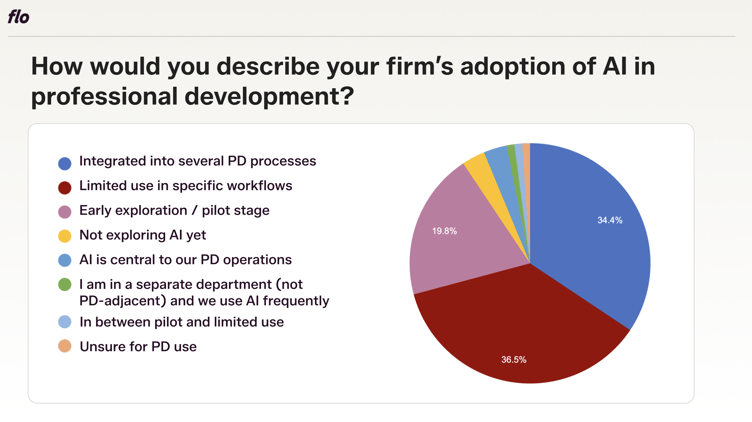
This signals a meaningful shift: AI is no longer confined to pilots or innovation teams. It is actively being used in day-to-day professional development work.
However, adoption is still uneven. Most firms are experimenting in targeted areas, rather than deploying AI consistently across the performance lifecycle.
Where AI Is Actually Being Used Today
When we look at where AI is showing up in performance-related work, the pattern is clear: firms are prioritizing efficiency and repeatability.
According to the survey:
- 53% use AI for drafting training materials
- 47% for administrative workflows
- 41% for performance review support
- 41% for coaching and feedback preparation
.png?width=752&height=423&name=AI%20results%20in%20PD%20(2).png)
These are not accidental choices. They share three characteristics:
- Time-intensive
- Structured outputs
- Lower perceived risk
In other words, firms are starting where AI can deliver immediate value without fundamentally altering decision-making.
However, this also highlights a gap between using AI and using it well. Most firms are applying AI to produce outputs faster, but far fewer are leveraging it to fundamentally improve how performance is measured, tracked, or developed over time.
What’s notably emerging:
- Competency tracking insights (18%)
- Knowledge management (12%)
These more advanced use cases require deeper integration and more trust in the underlying data.
One area that stands out is coaching and feedback preparation, where 41% of respondents report using AI. While often grouped with other efficiency use cases, this is qualitatively different because AI is not just supporting documentation, but beginning to influence how feedback is structured and delivered in conversations with attorneys. We know our friends at FringePD have significant experience with coaching in this area.
The Critical Question: What Role Should AI Play in Evaluations?
Performance reviews are where adoption becomes more nuanced and more cautious.
The data shows a clear hierarchy of comfort:
-
- Drafting assistance with human review — most common
- Data analysis support — second most common
- Administrative support only — moderate use
- Significant AI role in drafting — limited adoption
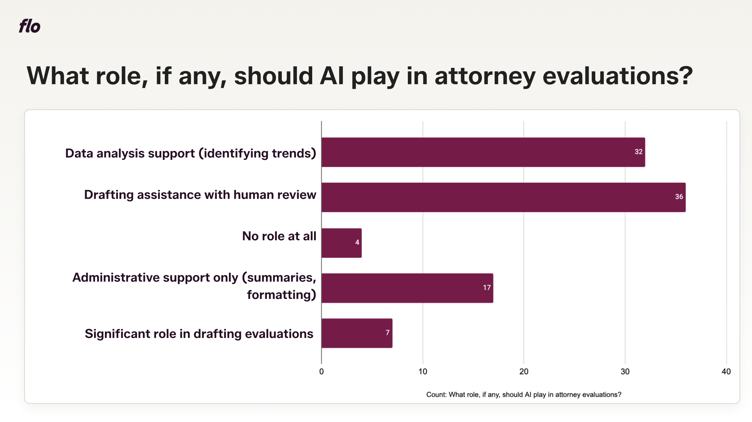
This reflects a consistent theme across responses: 
Or put more simply: firms trust AI to assist but not to evaluate. Even as AI becomes more capable, there is strong resistance to allowing it to replace human judgment in performance decisions.
But what we are seeing is an overall increase in adoption in the past year. According to a 2025 NALP Foundation research study, “Measuring What Matters: Evaluation Practices in Leading Law Firms,” 69% of firms reported not using AI at all in performance evaluations, with only small percentages using it for summaries or analysis. Since that study was published, we are now seeing AI used by over 70% of performance teams at various levels according to our survey.
Why Firms Are Drawing the Line
Knowing that firms and their professional development teams have high security and confidentiality priorities, three top concerns with AI are clear. Our open-ended text responses said that the hesitation isn’t about capability. It’s about risk, trust, and the nature of performance feedback itself.
Three themes came through consistently:
1. Efficiency vs. Quality
AI is widely seen as a way to improve speed and reduce administrative burden.
But that efficiency comes with a perceived tradeoff: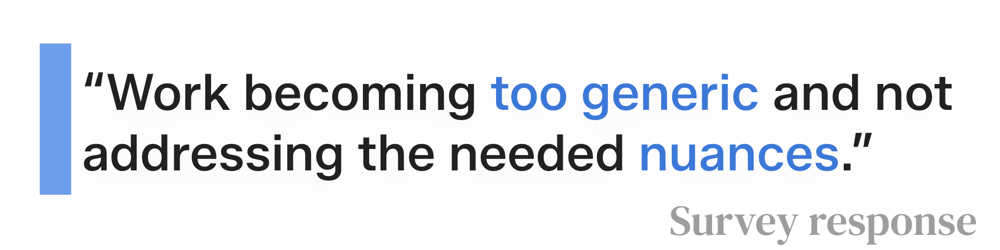 Performance reviews are not just outputs. They shape an employees’ perception that the firm is genuinely investing in their growth, development and progression. This is especially true when combined with mentorship and human judgment. If AI reduces that nuance, there is a risk of undermining that perception.
2. Confidentiality and Data Risk
Performance data is among the most sensitive information a firm’s talent team holds.
Respondents repeatedly raised concerns about:
- Data privacy
- Confidentiality
- Accuracy and hallucinations
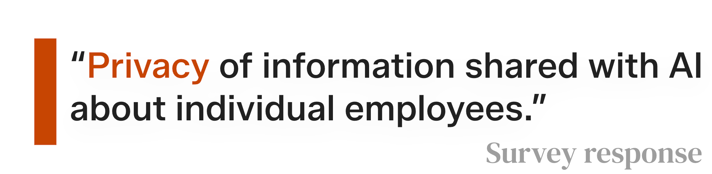
Until firms are confident in how data is handled, this will remain a major barrier to deeper adoption.
3. Over-Reliance on AI
Perhaps the most philosophical concern is also one of the most important: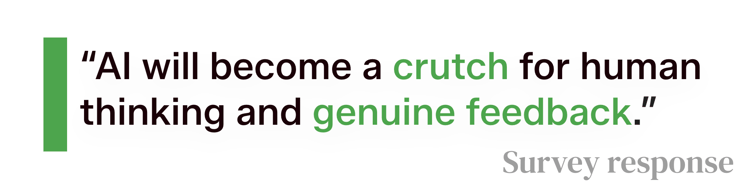 Performance management relies on judgment, context, and interpersonal accountability. Over-reliance on AI risks eroding all three.
A Clear Pattern: Assistance, Not Automation
Taken together, the data points to a consistent theme emerging across firms:
Where AI is being used:
- Drafting and summarization
- Pattern recognition
- Administrative efficiency
Where AI is not being trusted:
- Final evaluations
- Judgment calls
- Talent decisions
Firms are deliberately building “human-in-the-loop” workflows.
Firms are building a model where AI:
- Speeds up the process
- Improves consistency
- Surfaces insights
…but leaves decision-making firmly in human hands.
What This Means for the Future of Performance Reviews
The implication is not that AI will replace performance management,but it will reshape it.
We are already seeing early signs of this shift:
- Less time spent drafting and compiling feedback
- More time spent interpreting and discussing it
- Greater ability to identify patterns across teams
In this model, the role of professional development teams evolves from:
- Process management → Insight generation and advisory
The Bottom Line
AI is not transforming performance reviews overnight, but it is quietly redefining how they are built. The firms that gain the most value will be those that move beyond speed and begin using AI to enhance the quality, consistency, and insight behind performance decisions.
Firms are adopting AI where it adds efficiency and insight, while drawing a clear line around judgment, nuance, and trust.
That balance between speed and substance will define the next phase of AI in law firm performance management.
To learn more about how AI is used in Flo across our platform, reach out.