
In our last post, we identified four costs that often hide inside a performance review platform: the line item, the human hours, the hidden decisions, and the AI-capability gap. Looking across firms that haven't yet switched to Flo, we have noticed three common patterns behind why those costs tend to stick around. Each one plays out a little differently across the four categories, so let’s look at the math.
Pattern 1: Legacy platform and older HRIS modules
These are platforms built before legal-specific review software existed, so they're typically general HR products adapted, imperfectly, to a law firm review cycle. The line-item cost is moderate to high. The soft cost tends to be the highest of the three patterns because the platform wasn't designed for how law firms actually run reviews, so HR and reviewing attorneys end up working around it: tracking exceptions in a separate spreadsheet, chasing partners down manually, patching gaps the system doesn't cover. There's a hidden risk here too: simply having a system in place can create a false sense that "it's being handled," which can delay the harder conversation about whether it's actually working well. And on the AI-capability gap, most legacy platforms don't have much to offer yet.
Pattern 2: Built in-house
Smaller firms, and a handful of larger ones, build a custom review system on top of tools they already have, SharePoint, Microsoft Forms, and Power Automate. The line-item cost is near zero since there's no platform to license, and soft cost stays mid-range and stable because the system just runs as-is without a vendor pushing updates. This is where the hidden cost appears: no vendor means no roadmap, integrations built by internal IT on limited time tend to stay brittle, and the knowledge of how it all works usually lives with one or two people, so if they leave, the firm can be stuck with a system no one knows how to fix. The AI-capability gap is the toughest part of this pattern: those workflows have nowhere to go, because there's no one building a roadmap to add them to.
Pattern 3: Paper, spreadsheets, or PDFs
This pattern is more common than the industry tends to talk about: reviews collected in Word, scored in Excel, and stored in shared drives. The line-item cost is zero, but the soft cost is high, since each cycle often starts close to scratch. The hidden cost is the highest of any pattern, with little longitudinal signal, no consistent rubric, and not much to fall back on if a promotion decision is ever challenged. The AI gap isn't really on the table here. There's no platform for AI to sit inside yet.
Modern general-purpose vs. legal-purpose-built
Once a firm decides standing still has a cost, the next question is what to switch to. Modern general-purpose platforms like PerformYard, SuccessFactors, Workday, and Lattice are real improvements over legacy systems. They tend to have cleaner UX, better integrations, and active product roadmaps. For a non-legal company, they're often the right answer.
For a law firm, though, non-legal platforms tend to leave much of the soft-cost category in place. Review cycles at law firms follow their own structure, associate class years, partner-track decisions, practice group rotations, and a mid-year plus year-end cadence, and that structure doesn't always map cleanly onto general HR products. The IT and configuration overhead drops, but the HR and reviewing-attorney overhead tends to stay roughly where it was.
A legal-purpose-built platform is designed around those structures from day one. The configuration overhead is dramatically lower. The HR and attorney hours per cycle drop because the tool isn't being bent to fit the workflow. On the AI-capability gap, a platform built for legal reviews can offer workflows tuned to the specific data shape of a legal performance review: narrative prompts, calibrated competencies, partner-track signals, rather than generic HR templates.
The cost most firms rarely count: decision quality
The hidden-decisions category touches on costly promotion decisions, but the decision-quality story goes further than that. Every performance review cycle is, in aggregate, a series of decisions about who to invest in, who to coach, who to promote, and who to manage out. A platform's job is to help keep those decision signals clear, calibrated, and longitudinal, meaning they hold up and stay comparable from one cycle to the next.
When signals live in scattered PDFs and Word docs, decisions tend to get noisier. When narrative feedback is buried in nested folders, decisions tend to slow down. And when competencies aren't tracked across cycles, decisions become harder to defend. None of these costs show up on a procurement spreadsheet, but if you've ever had a managing partner question why a particular promotion happened, or watched a class year lose three associates in a quarter, you've likely paid this cost.
The math, for a representative firm
Consider a 350-attorney AmLaw 200 firm running an attorney-only review cycle. Using reasonable, illustrative inputs (your actual numbers will vary and Flo's Cost-of-Cycle worksheet calculates the version specific to your firm):
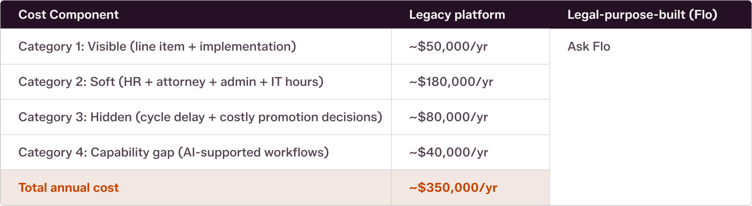
The visible-cost gap is close to nothing. The real difference sits in categories 2, 3, and 4, and Category 4 is the line most likely to keep growing the longer a firm stays on a platform that doesn't support AI-assisted workflows. For a 350-attorney firm, the annual difference between legacy and legal-purpose-built typically lands in the $180,000 to $250,000 range. Over a five-year platform decision horizon, that difference is roughly $1 million.
Standing still is a decision
The most common misconception about performance review platforms is that not switching is the safe choice. That's not quite right. Standing still is still a decision, one that means continuing to pay the soft cost, absorb the hidden cost, and watch the capability gap widen a little more each year. It deserves the same close look as the decision to switch.
If you haven't run the numbers on your current platform recently, it's worth doing. Start with the line-item cost, then estimate the HR, attorney, admin, and IT hours per cycle and multiply by realistic hourly rates. Add in the cycle-time delay and the cost of a promotion decision that doesn't hold up, then add the capability gap on top, the cost of running cycles where your team can't yet do what 71% of PD leaders are already doing with AI elsewhere. See what the total comes to.
If the math says standing still is the right call for your firm, that's a defensible answer, and worth knowing. If it says you've been quietly paying a six-figure premium for years to avoid switching, that's also worth knowing, before the next renewal.
Get a Cost-of-Cycle analysis
We built a worksheet that calculates all four cost categories for a firm of any size, against any incumbent (legacy platform, in-house build, or paper). It uses industry-standard ratios for HR, attorney, admin, and IT hours, and we can drop in your firm's actual numbers. No demo required to get your numbers.
Email marketing@joinflo.com with your firm size and current platform, and we'll send the numbers back by the next business day. Or visit https://www.joinflo.com/roi-calculator to run the numbers yourself.
Flo · Performance management built for law firms · joinflo.com · Published [DATE]
Sources: Flo May 2026 PD Leaders Survey (n=96, conducted April 14 - May 1, 2026). NALP Foundation 2025 Measuring What Matters: Evaluation Practices in Leading Law Firms (n=100 firms).