A performance review shapes how an attorney is perceived, developed, and advanced. That makes the writing high-stakes, and hard to get right. A comment can come across harsher or vaguer than intended. Coded language can slip in without the reviewer noticing. And reading every comment for tone by hand simply doesn't scale.
Flo Performance Management now includes three capabilities that address this directly, from the moment a review is written to the moment it's synthesized.
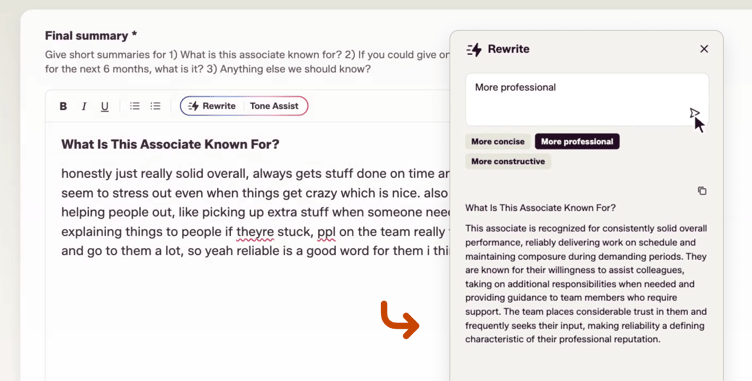
AI Rewrite takes a reviewer's messy notes or stream-of-consciousness thoughts and turns them into a polished, cohesive review. Partners and managers can choose from prompt options like "more concise" or "more direct," or give AI Rewrite custom instructions. It only works with what's already been written; it never adds examples or details the reviewer didn't provide. The substance stays with the human.
AI Tone Assist checks a review as it's written and flags language that may read as vague or problematic, explains why, and suggests a fix, whether that's adding a concrete example or swapping out a word. It catches gendered or coded language applied unevenly across groups, references to EEOC protected characteristics, vague feedback with no example behind it, unprofessional language, and overused HR clichés. The flags are informational only. Tone Assist never blocks a submission.
AI Summary picks up where the individual review leaves off. When an admin or consensus reviewer sits down to synthesize evaluations for a single attorney, the real work is finding patterns across responses and forming a coherent picture, but the reading and collating that come before it eat up the time, especially when a reviewee has feedback from many evaluators across different competencies. AI Summary, available directly from the reviewee drawer, generates that recap automatically, so admins (and consensus reviewers, when that access is enabled) can pull it up without leaving the page they're already on. Every finding is grounded in supporting quotes pulled from the underlying evaluations, not just a top-line narrative. Admins can also choose the format: a flowing paragraph narrative, or bullet points for a faster scan, since some reviewers want the full picture before forming a view and others want to hit the key points fast.
Together, the three give reviewers a chance to catch and correct issues before feedback reaches a reviewee or becomes part of the formal record, and give admins and consensus reviewers a way to spend their time on judgment and calibration instead of manual collation. Professional development and HR teams get a consistent standard across reviews, without relying on manual oversight alone.