.png?width=65&height=65&name=Frame%201%20(5).png "Flo logo")

- Recruiting Technology
- 2 mins
Knowing where every attorney stands in your pipeline, at any moment, is a basic requirement for running a serious recruiting operation. That kind of visibility has been harder to come by than it should be, and it's one of the things we kept hearing about. Flo is the fastest shipping company in the legal talent industry, and this one has been a long time coming: status logging for the applicant tracking system is live.
The problem
Before this, recruiting teams were largely working from snapshots. You could see where an attorney sat in the pipeline right now, but the history of how they got there was either missing or living in someone's notes. If a status was entered incorrectly, or a stage was skipped by accident, there was no clean way to fix it.
That gap had real consequences. Without a reliable history of stage transitions, calculating conversion rates between stages was guesswork. Measuring time-to-hire meant piecing together dates from emails or calendar invites. Recruiting teams were doing serious analytical work on top of incomplete data, and everyone knew it.
What we shipped
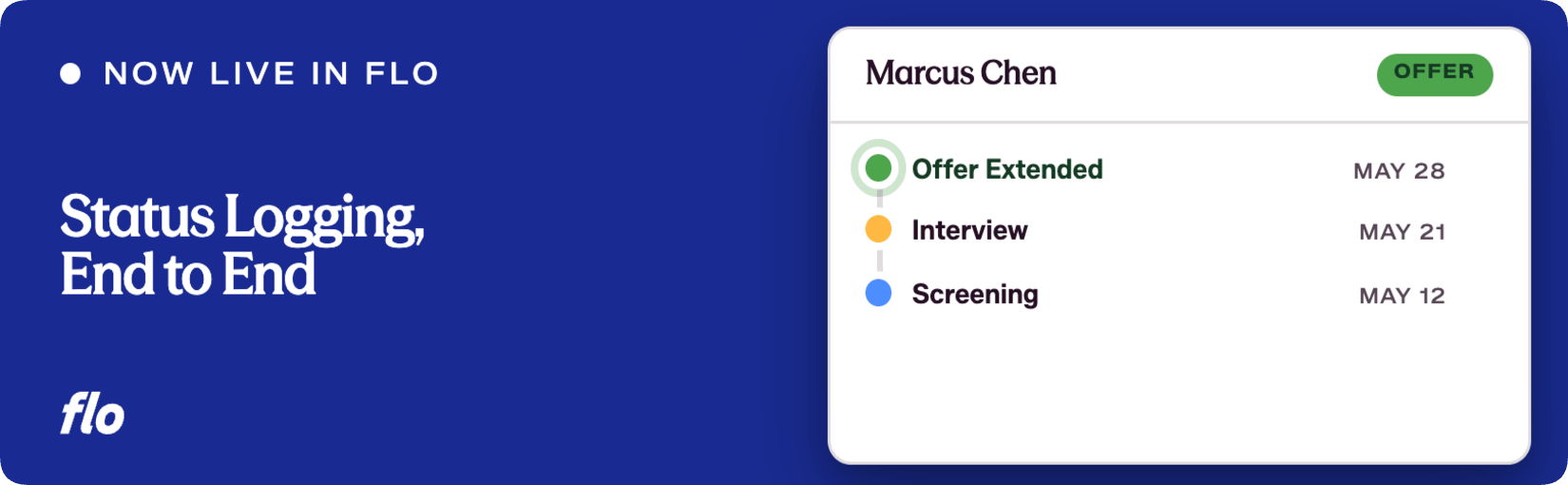
Status logging gives admins a complete, chronological record of every pipeline stage an attorney moves through. The log is built automatically as candidates progress, so there is no extra work required to capture the history..png?width=886&height=988&name=image%20(3).png)
Where the record needs correction, admins have the tools to fix it cleanly:
- Edit a status date or time if it was recorded inaccurately.
- Remove a status that was added by mistake.
- Add a missing status if a stage transition was not captured at the time.
.png?width=852&height=1042&name=image%20(4).png)
Alongside the status log, every change made to that log is captured in an Audit Trail. The Audit Trail shows exactly what was changed, who made the change, and when, giving admins a complete and trustworthy record of the data.
Why it matters
Reliable stage history unlocks reporting that recruiting teams have been asking for. Conversion rates between pipeline stages, time-to-hire calculations, and bottleneck analysis all depend on accurate, complete data. Status logging provides that foundation.
The Audit Trail matters too, particularly for teams where multiple admins are touching candidate records. When a question comes up about a data point, there is now a clear answer about what happened and who made the call. That kind of accountability reduces friction on teams and keeps the data trustworthy over time.
And because admins can correct the log, the system does not become a liability when a human error happens. You can fix it, keep the record accurate, and move on.
This feature reflects something we have been working toward with recruiting teams for a while. The pipeline visibility problem is not new, and we are glad to finally have a real answer to it. Keep telling us what is still slowing you down, because that is exactly how we decide what to build next.
If you are not yet on Flo and want to see status logging in action, book a demo and we will walk you through it. And if you are a lawyer curious about the opportunities on the other side of this platform, you can create a Flo Forward account to explore your career opportunities at your own pace.