Offers now come earlier than they used to, often before a student has a full set of grades on their transcript. That makes the summer program more important, not less. It is the longest, closest look your firm gets at a future associate before you make an offer. It is also the longest, closest look they get at you.
New data from the NALP Foundation's 2026 study, U.S. Law School Alumni Employment & Satisfaction: Class of 2022, which surveyed 1,711 law school graduates three years after graduation, shows how much is still in motion during those summer weeks. Here is what it suggests firms should watch for, and how feedback and evaluations shape both sides of the decision.
Career plans are still forming during 2L year
Nearly half of alumni (45%) said their intended career setting shifted while they were in law school. Of those, 48% said the shift happened during 2L year, more than in 1L (35%) or 3L (26%) year. The most common reason was simple: their interests changed (70%).
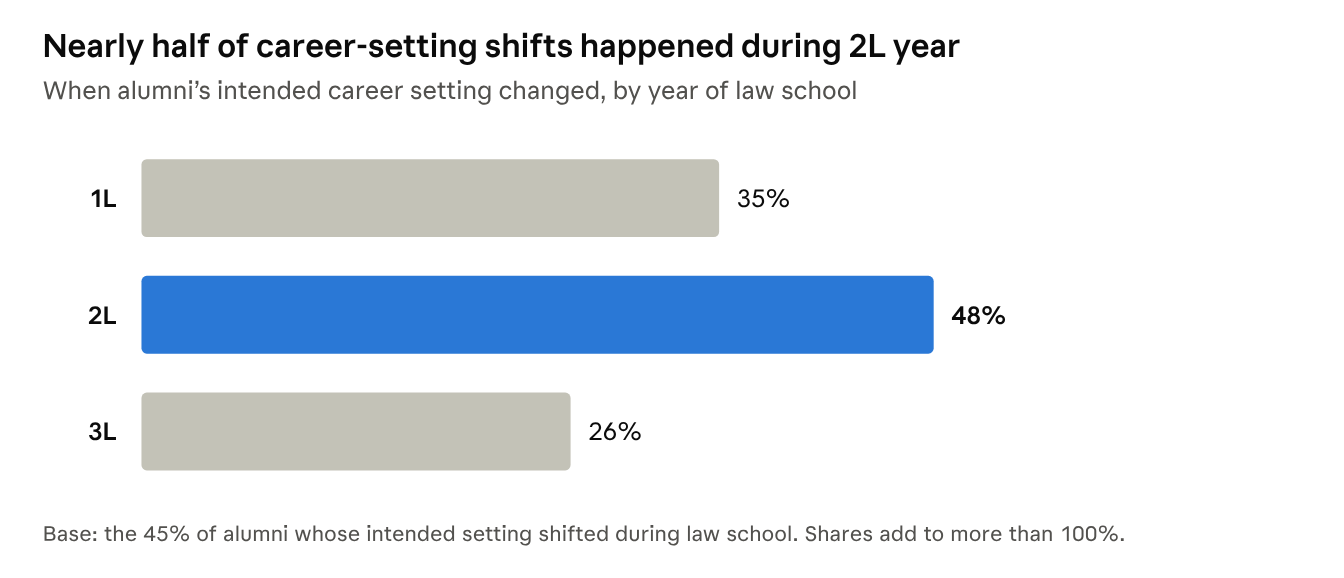 For most firms, 2L year includes the summer program. The work summer associates do, the people they work with, and the feedback they get all play a part in whether their interests move toward your firm or away from it. Nearly a quarter of alumni (24%) secured their first post-graduation job between 2L and 3L year, and another 38% during 3L year, so the summer and the weeks after it are where intent turns into an accepted offer.
Look past the memo: the skills new lawyers say matter most
The study asked alumni to rate each skill twice: how much it matters in their job today, and how well law school prepared them for it. In the chart below, the blue dot shows how much a skill matters and the gray dot shows how prepared alumni felt. The wider the gap between them, the more new lawyers are learning on the job. Practice management, business development, and teamwork top the list, and each is something a summer program can help build and assess.
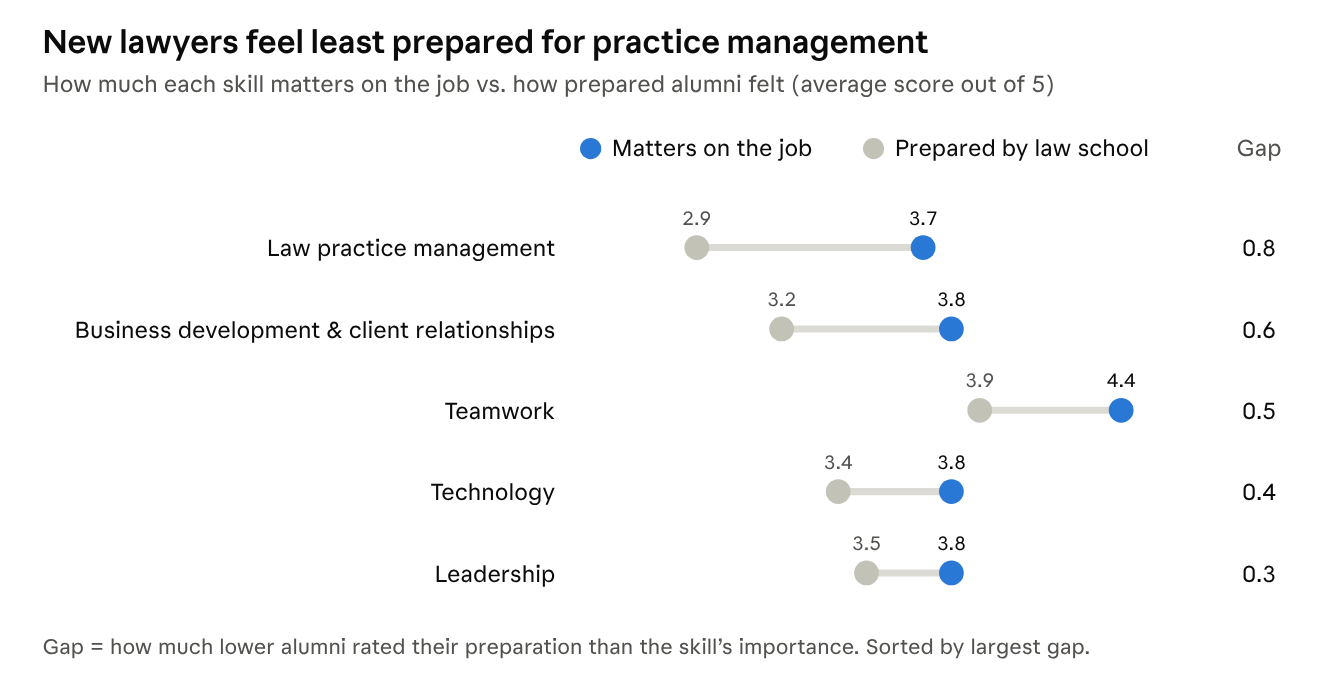 Mean scores on a 5-point scale.
These are skills a summer program can actually observe. How does a summer associate work with a team on a deadline? Do they take ownership of a project and manage it to the finish? Are they comfortable with the tools your attorneys use, including AI? About half of alumni (48%) already use AI frequently or occasionally in their current roles. If your evaluations only score the work product, you may be missing the signals that matter most for the associates they will become.
Feedback shapes how associates see your firm
Among alumni who changed jobs, attitude or fit concerns (40%), the desire for mentors or role models (36%), and no clear advancement path (29%) were among the top reasons they left. Those concerns rarely appear out of nowhere in an associate's third year. They often start with early impressions of how a firm develops people.
The summer program is the first test. Summer associates notice whether feedback arrives during the summer or only at the end, whether it is specific enough to act on, and whether the attorneys giving it seem invested in their growth. After graduation, alumni named colleagues and professional peers (64%) and employer programs and events (53%) among the most helpful resources for developing their professional identity. Firms shape that identity early, starting with how they give feedback.
A structured mid-summer check-in, not just an end-of-summer review, gives summer associates time to act on feedback and gives your team an earlier read on fit.
Build evaluations that help you anticipate success
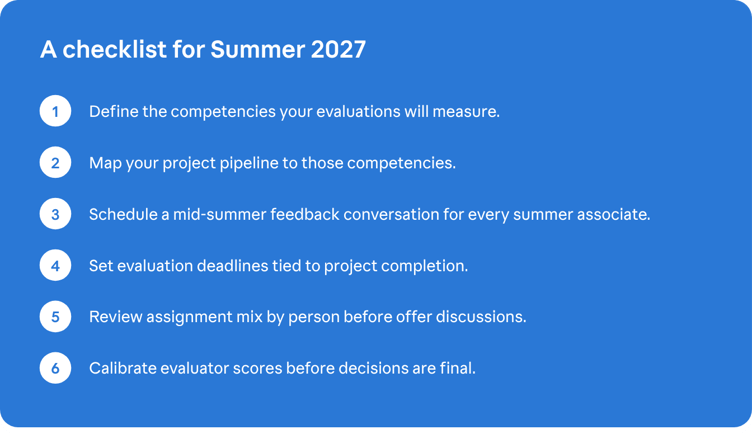
If summer evaluations are going to inform offer decisions, they need to measure the same things for every summer associate. A few practices make them more useful:
- Use shared criteria across evaluators. Define the competencies you care about, including teamwork, judgment, and ownership, and ask every attorney to score against them.
- Map assignments to those competencies. A summer associate can't show client skills or project management if their assignments never call for them.
- Collect feedback while the work is fresh. Request evaluations when a project wraps, not weeks later.
- Calibrate before offer conversations. Review evaluations side by side so one generous or tough reviewer doesn't decide an outcome.
How Flo helps: Keep processes simple and streamlined
Flo Work Allocation keeps summer projects, feedback, and evaluations in one place. Attorneys get automated feedback requests and reminders, admins can see evaluation status by project and enter feedback on an attorney's behalf, and review packets are built by group when it's time for offer conversations. Firms can also see each summer associate's projects by stage, so assignment gaps show up before the summer ends.
Want to see how it works for your 2027 summer program? Join our Work Allocation group demo on Dec. 9.
Data source: NALP Foundation and NALP, U.S. Law School Alumni Employment & Satisfaction, Class of 2022 (2026). Respondents include 1,302 U.S. alumni from 26 law schools and 409 Canadian alumni from 14 law schools. Figures in this post appear on pp. 12, 21, 23, 27–28, 44, 51, and 54 of the study's webinar deck.