.png?width=65&height=65&name=Frame%201%20(5).png "Flo logo")

- Performance Management
- 2 mins
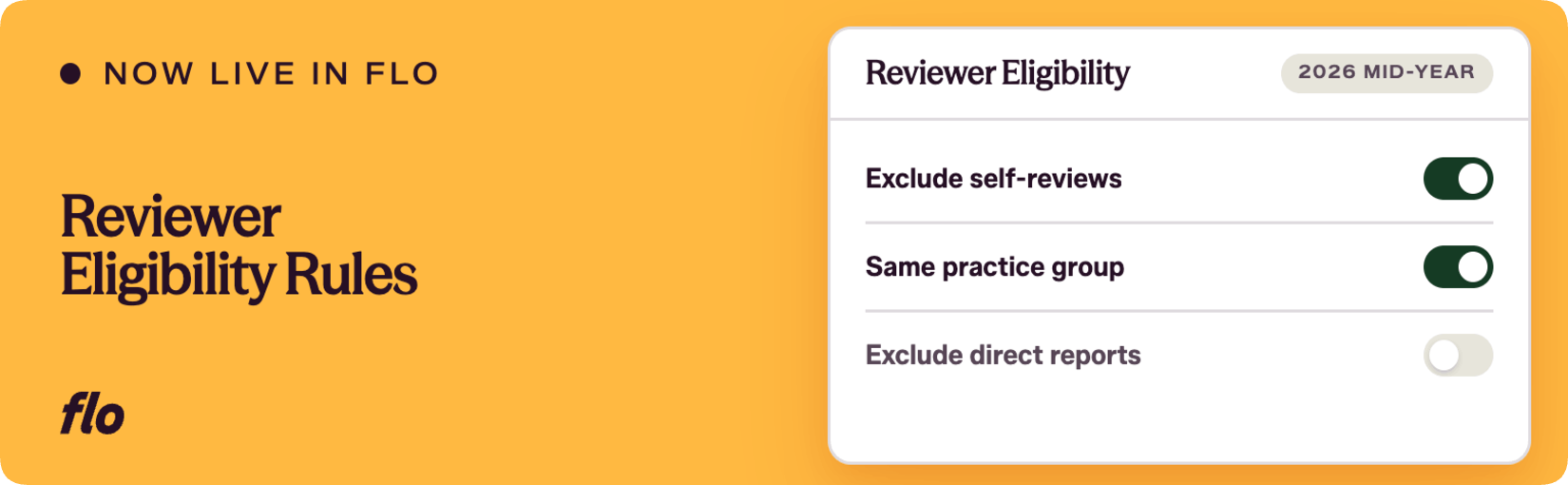
Performance reviews only work when the right people are doing the reviewing. Flo is the fastest shipping company in the legal talent industry, and the latest addition to Flo Perform puts that speed to work on a problem that Professional Development and HR teams have been navigating manually for too long: controlling exactly who is eligible to review whom, at scale, without relying on everyone to follow an unwritten convention.
The problem
In most review cycles, the assumption is that people will select reviewers sensibly. In practice, that assumption breaks down. Without guardrails, attorneys end up in review pools where the level mismatch makes the feedback less useful or, worse, creates process problems that admins have to clean up after the cycle closes.
Talent and HR teams told us they were spending real time policing reviewer assignments, either catching mismatches before they caused issues or correcting them after the fact. The configurations that made sense for their organizations lived in someone's head or in a separate document, not in the system doing the work. There was no way to encode the rules and have them enforced automatically.
What we shipped
Admins can now configure Reviewer Eligibility Rules directly in cycle settings. The feature lets you build level-based rules that define which reviewers can evaluate which employees, for example: reviewers at a given level can review employees at a specific level, and above, or below, or only at that exact level. Rules are configured per review cycle, so you can apply different logic to different cycles without one set of rules bleeding into another.
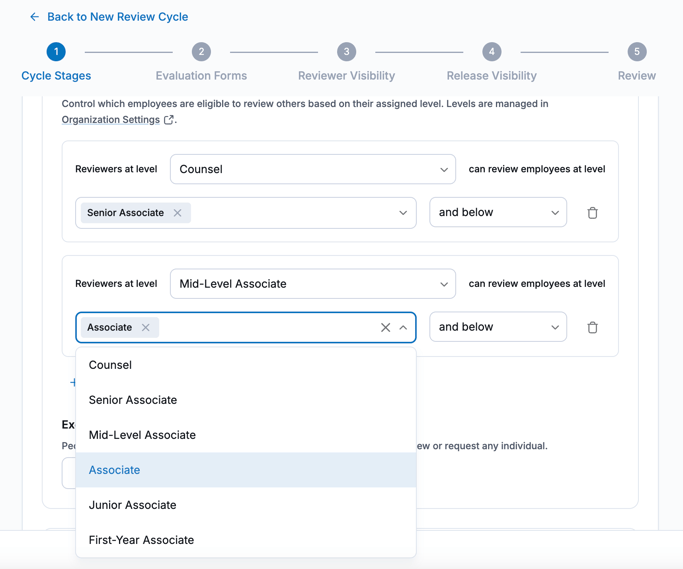
The feature is toggled on or off at the cycle level, which means you can adopt it incrementally. And for situations where the rules do not fit a specific person, there is an Exceptions list: individuals added there are exempt from all rules, no workarounds needed.
Enforcement runs across the full review experience:
- Standard, matter-based, and self-assign reviewer selection: Attorneys only see reviewers who are eligible for them under the current rules.
- Unsolicited Reviews: Reviewers only see employees they are eligible to review.
- Assign Reviewers modal: Admins retain full control. If you try to assign an ineligible reviewer, you will see an inline warning, and you can still proceed if the situation calls for it.
Levels themselves are managed in Organization Settings, keeping the source of truth in one place.
Why it matters
The practical impact is that the rules your team has always applied informally are now built into the system. Attorneys navigating reviewer selection see a filtered, appropriate list rather than having to know or guess who is a reasonable choice. Admins are not left cleaning up mismatches after a cycle closes.
The inline warning in the Assign Reviewers modal is worth calling out specifically. It preserves admin judgment: if there is a legitimate reason to assign someone outside the standard rules, you can do it, but the system makes sure you are doing it consciously, not by accident.
For organizations running multiple review cycles with different structures, the per-cycle configuration means eligibility logic can flex with the cycle design rather than forcing a single global rule onto every context.
Reviewer Eligibility Rules is live now in cycle settings. If you want to see how it fits into your review cycle design, book a demo and we can walk through the configuration together. And as always, keep telling us what is still slowing you down. This feature came out of real friction you described, and that is exactly how we want to keep building.